
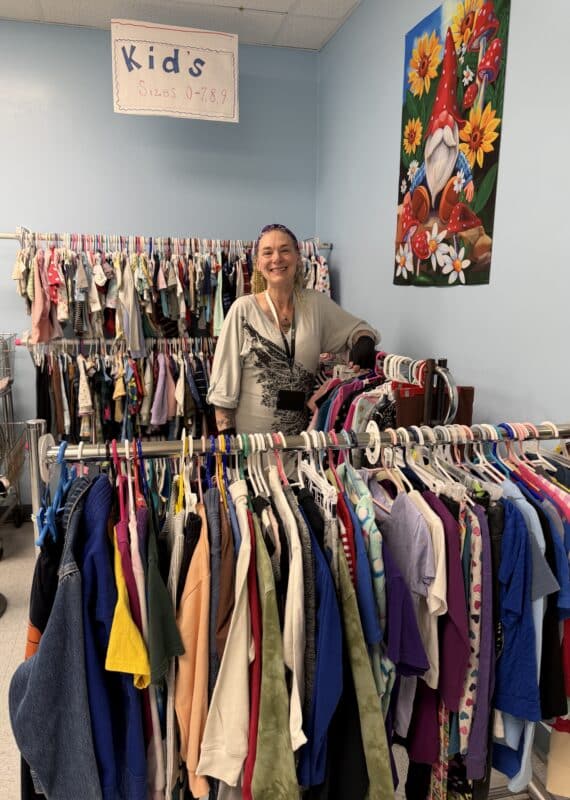
On a Tuesday morning in late April, the former parish hall at Augusta’s Emmanuel Lutheran Episcopal Church is arranged much like a boutique, welcoming visitors to browse through carefully organized racks and baskets of gently used apparel before having their selections packed up by a friendly volunteer at the front counter. Named Addie’s Attic, the free clothing bank is overseen by Melissa Furrow, who maintains it with scrupulous attention to detail. “Every single piece has at least four pairs of hands on it before it goes in there, to make sure there are no stains, holes, or even a little rip,” Furrow says as she works in a storeroom where the items are sorted and shelved.
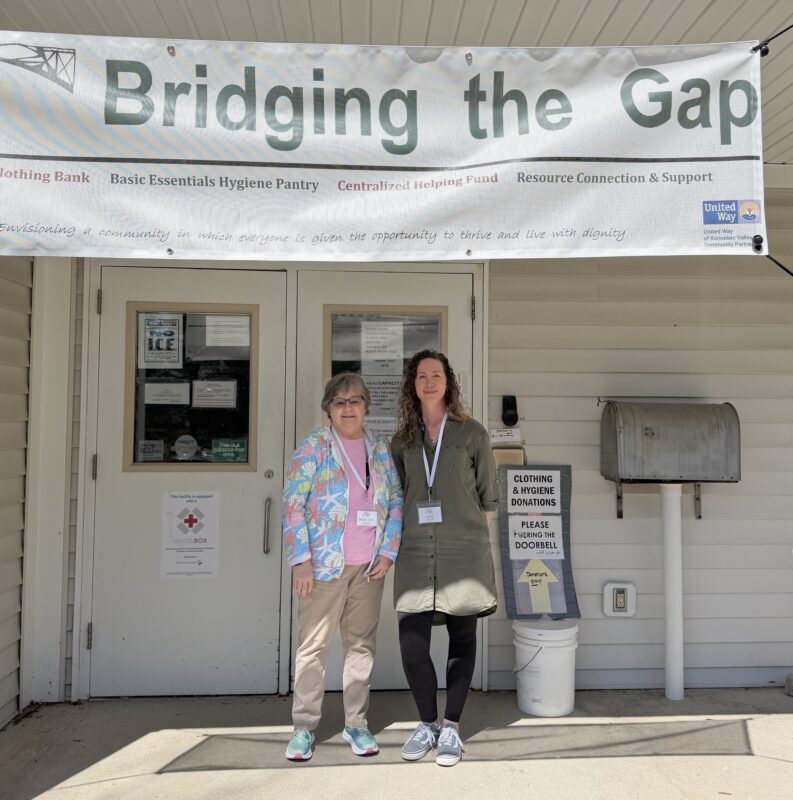
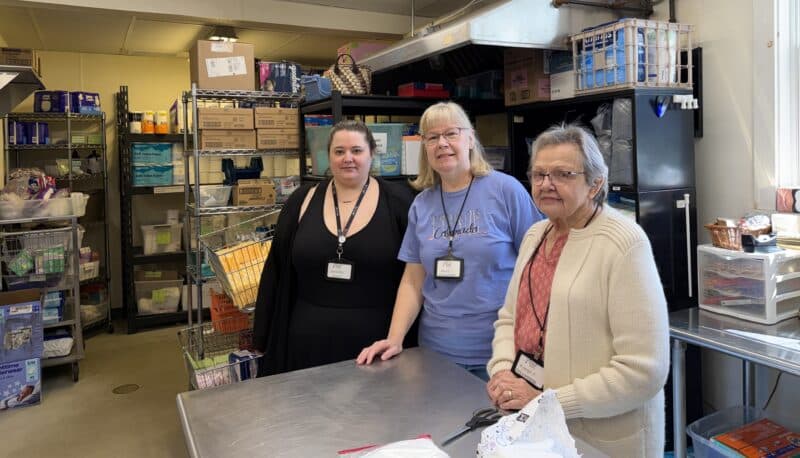
Addie’s Attic is one of three primary ministries offered by Bridging the Gap (BTG), headquartered at the church since 2018 and open on Tuesdays and Thursdays. Others are the Basic Essentials Hygiene Pantry—housed in the church’s former professional kitchen—and the CHEF (Centralized Helping Fund) program, which provides financial assistance for everything from rent and utility payments to car repairs and groceries, as well as referrals to other resources. In May, CHEF distributed just over $3,000; Addie’s Attic served 964 individuals; and the Hygiene Pantry—which distributes soap, toothpaste, diapers, sanitary products, toilet paper, and other basics— served 1,009. Nearly 40 percent of those were new Mainers, which represents a significant increase from a year or two ago, says Bobbi-Jo Burdin, BTG’s interim executive director for the last year.
Burdin is grateful for the recent arrival of CHEF Program Director Sarra Maddocks, who has a background in case management and is in her final year of study for a master’s degree in clinical mental health counseling. “Sarra has been a godsend to Bridging the Gap,” says Burdin. “She is so knowledgeable and kind, and she’s able to assist people in many different ways. She has helped our program immensely.”
Maddocks’ experience has given her the tools to help BTG’s guests access vital services even if they don’t qualify for traditional case management. “Coming here has allowed me to use all of my skills with connecting folks to resources, but also assessing what needs might not be so apparent,” Maddocks says. “I’ve been able to work with our guests by suggesting services to help them live their best, most holistic, healthy lives possible. We get to help people without getting caught up in systemic red tape”
Referrals to BTG come from a range of sources: case workers, domestic violence shelters, behavioral health centers, and the Augusta Police Department’s Community Response Team. When the center is open, a rotating group of services—which might include the Capital Area New Mainers Project, Augusta Food Bank, Career Center, and Maine General Harm Reduction— staff tables in a lobby-like space to offer BTG clients further support.
Addie’s Attic and the Basic Essentials Hygiene Pantry both got their start at St. Mark’s Episcopal Church in Augusta, whose congregation relocated to Emmanuel (then called Prince of Peace Lutheran Church) in early 2015. The two ministries continued to operate out of St. Mark’s parish hall until the building was sold and moved to Emmanuel in June 2018 under the name Bridging the Gap. When St. Mark’s Home, founded in 1870 as a home for indigent women and overseen by the church, was sold that same year, its nearly $600,000 endowment went to Emmanuel, where it is overseen by a group of trustees who are also church leaders. The annual interest provides the financial underpinning for BTG’s payroll and other basic expenses.
For a while there was discussion about BTG becoming its own 501c3 nonprofit, but Emmanuel’s rector, the Rev. Ben Cooke, says it was clear when he arrived in early 2025 that wasn’t going to work. “The congregation decided that this is our outreach ministry and we are going to support it,” Cooke says. “A high point of that was the big yard sale that we just did as a fundraiser. We had volunteers from BTG, the church, and the community all working together.” The event, billed as a Community Market, also included outside vendors and raised just over $1,500.
Where once the double doors that divide the church and parish offices from the parish hall and other rooms used by BTG were always closed, today they stand open, signifying physically and symbolically that the church and its core ministry are closely linked. Another big change, according to Cooke, is that the staff of BTG, which is half the size it was at the start of 2025, now feels comfortable asking him and other church staff members to step in and help. “That was not the case when I first started here,” he says. “There’s a big sense of support that feels really positive for everyone, and a little bit like returning to the core of how BTG originally functioned, but it’s also stepping forward by being more professional. It makes more sense now.”