The Communications Department launched “Dio Maine Cooks: Recipes and Stories from Vintage Church Cookbooks” in January 2025 as a way to explore the history of Maine’s Episcopal churches through the cookbooks in our diocesan archives. Created as a way to fundraise and/or mark an anniversary, these spiral-bound church cookbooks capture a moment in time, whether that moment is in the 1940s or the 1980s. The recipes they contain are tried and true favorites that have graced tables at countless church coffee hours, potlucks and progressive dinners. Do you have a Maine Episcopal church cookbook you’d like to donate to the archives? Email us here!
When you hear or read the words, “island in Maine” what images come to mind? They probably include moss-carpeted pine woods, coves dotted with weathered fishing boats, and shingled cottages perched along a craggy shore. According to the Rockland-based Island Institute, coastal Maine has more than 4,000 islands, including those that are inhabited and not, those close to the mainland and miles out to sea, islands accessible by bridge and only by boat. “On their own, each Maine island represents a unique opportunity to understand and celebrate the Maine coast from a different natural vista, through the eyes of a well-established community, or from a working waterfront that connects Maine’s iconic lobsters to the rest of the world.” Together, islands are a defining characteristic of our state.
They are also home to six of our 17 summer chapels. If you have a really good arm, you might be able to throw a ball from the northeastern shore of Georgetown Island and have it land on MacMahan Island. On the western side of the Sheepscot River not far from where it meets the Atlantic, MacMahan—like its island neighbors, Squirrel, Capitol, and Isle of Springs—was established as a summer colony in the late 19th century. Reachable only by boat, it has no hotel, restaurant, or market. What it does have is acres of pristine woodlands, quiet beaches, 40 cottages, and one of those island chapels—St. Cuthbert’s.
At least two of the island’s early summer residents were Episcopal priests, and as in other Maine summer communities, church services were initially held on MacMahan’s cottage porches. According to St. Cuthbert’s records, “At the close of the summer of 1899, a meeting was held at Robinhood Cottage of those interested in building a Chapel, at which meeting, Mr. E.B. Nealley and Mr. George E. Hughes, representing the owners of the Island offered a lot of land on which to build a chapel for the services of the Protestant Episcopal Church.” The following year, the committee put out a circular seeking contributions from “lovers of the Island” to a building fund, to which the newly installed third Bishop of Maine Robert Codman replied, “The object of your subscription meets with my hearty approval.”
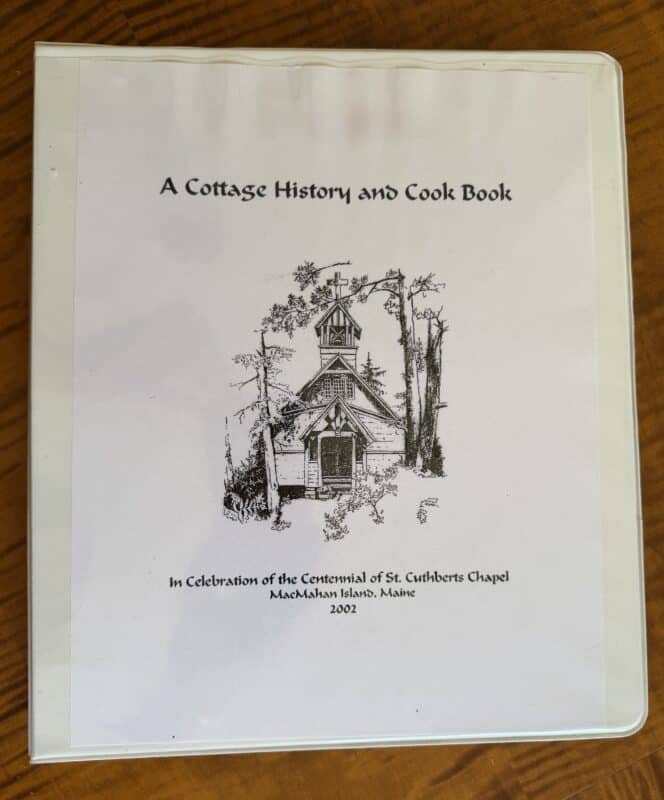
These archival nuggets introduce “A Cottage History and Cookbook,” created by St. Cuthbert’s members Sally Jones and Margie Platou to celebrate the chapel’s 2002 centennial. The most unusual cookbook (so far!) in the diocese’s collection, the ring-bound book offers fascinating details about 39 cottages and their inhabitants, each cottage story accompanied by at least one recipe.
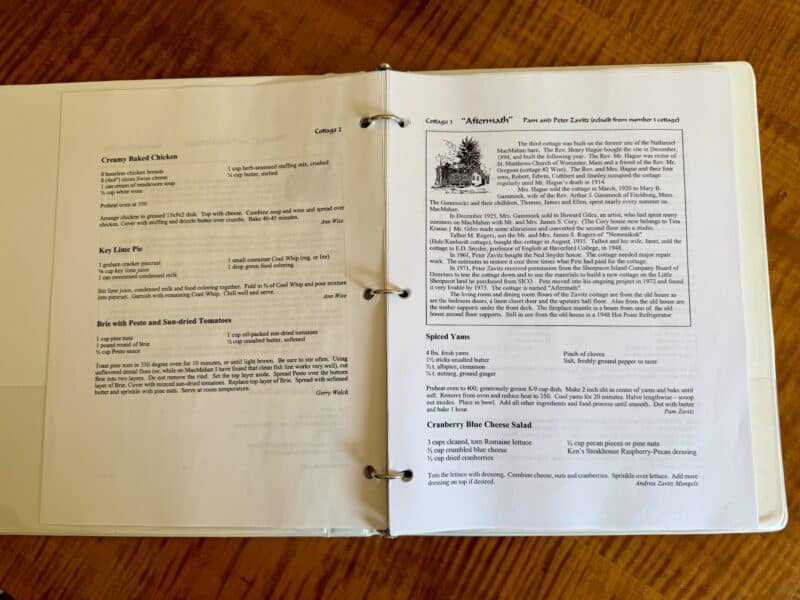
Cottage #3 was built by St. Cuthbert’s original committee member the Rev. Henry Hague and went through a few different hands before it was purchased by Peter Zavitz in 1961. Finding it in need of expensive major repairs, Zavitz later tore the cottage down, and after rebuilding it using flooring, doors, and beams from the old house named it “Aftermath.” According to the Cottage #3 page, “Pete moved into his ongoing project in 1972 and found it quite livable by 1973.” Among the 11 recipes contributed to the book by the Zavitz family are Fat Man’s Shrimp and Six-Week Muffin Mix (remember that seemingly endless bowl of bran muffin batter from the 70’s?).
The book’s recipes run the gamut from easy casseroles to feed a crowd of summer guests and retro classics like tomato aspic and homemade “Boursin” cheese, to sophisticated fare such as Chestnut Soup and Smoked Salmon Napoleon with Chive Crème Fraîche and Sevruga Caviar contributed by the Cole family of Cottage #28, “Westcote.”
The Taft family has owned Cottage #14 since 1908, when the Rev. Arthur Nelson Taft purchased the speculation-built house sight-unseen and brought his wife and three children to the island from their home in Colorado Springs, Colorado. Taft is credited with being one of the summer residents to realize that “the trees on MacMahan were growing so fast that the cottages were being shut off from both the air and the view,” according to the Cottage #14 page. In addition to cutting down some of the offending trees, he bought a nearby cottage and gave it to a friend who moved it to another part of the island—out of the way of Taft’s view.
The fifth generation of Tafts now enjoys summers in the family cottage. In 1981, Alexander (Sandy) Taft, Jr. inherited Cottage #14 from his father and along with his wife, Ann, and their three children made the long trip to Maine from Louisville, Kentucky, every summer. Before the advent of remote work, Sandy Taft, like many men of his generation, had to return regularly to his Louisville office, which required Ann becoming comfortable with piloting their 13-foot Boston Whaler to Georgetown’s Robinhood Marina so she could drive him to the airport. “I had to pass the MacMahan test,” Ann says. “The first time, there were men watching me from the bushes to make sure I was okay.” Ann also took the boat up the Kennebec River to Bath, where she would shop at Brackett’s and the Bath Farmer’s Market on Saturdays. Fish, of course, came from local fishermen, including swordfish steaks for the Tafts’ signature recipe: Taft Swordfish Picnic. Held on one of the area’s small, uninhabited islands, the picnic also requires boating prowess to pull off. “Every summer we try and have a picnic late in the afternoon in order to have time to build a cooking fire from driftwood, enjoying the beauty of Maine and have a delicious meal,” the recipe’s introduction reads.
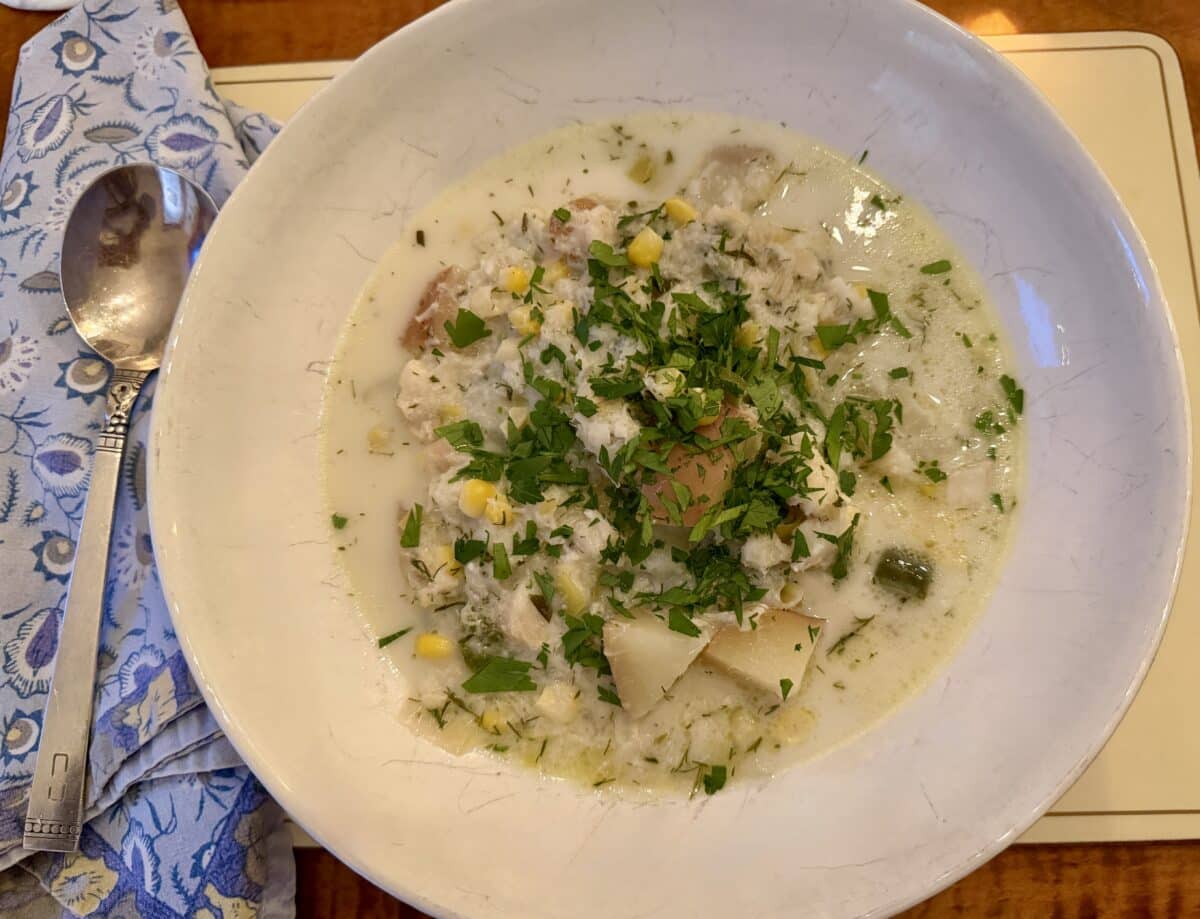
While the picnic sounds spectacular, it was a bit much to orchestrate for this column (email me if you’d like the recipe). Ann happily recommended several other recipes from the book, including this easy (baked in the oven!) and especially flavorful fish chowder from Jan Platou of Cottage #34. Jan, a native of Norway, and his wife Margie bought the house, originally named Rip Tide, in 1988 and renamed it “Hytta,” which means cottage in Norwegian. The candied ginger in this recipe is an interesting touch, but the chowder is equally delicious without it.
Fish Chowder
By Jan Platou
Adapted slightly from “A Cottage History and Cookbook,” by St. Cuthbert’s Chapel, MacMahan Island, Maine
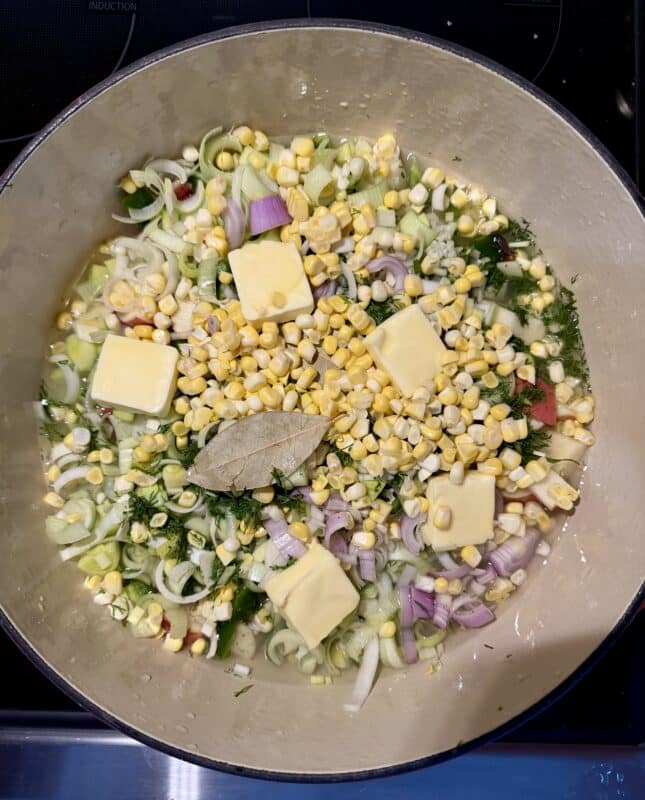
Note: I didn’t have quite enough leek, so substituted a chopped shallot, and added the kernels from a lone ear of fresh corn that was hanging around in my fridge.
1 ½ lbs. cod or scrod fillets, cut into 2 – 3-inch pieces
4 medium to small potatoes, diced
1 cup diced green (or red, or mixed) pepper
2 cups sliced leeks (about 1 large leek, white and tender green parts)
2 garlic cloves, minced
2 bay leaves
5 cloves
2 tablespoons chopped fresh tarragon or fresh dill
4 tablespoons butter
½ cup dry vermouth
2 cups boiling water
Salt and pepper
1 cup half & half (or milk), brought to room temperature
Candied ginger, chopped
Chopped parsley
Preheat oven to 375. In a 2½ qt. Pyrex casserole with a fitting lid (I used an enameled cast-iron Dutch oven), place the fish and the remaining ingredients in the order listed, except the last three. Cover and bake for one hour.
Add the half & half or milk. Stir to mix and break up fish pieces.
Put about one tablespoon of the candied ginger in each bowl or plate, add the chowder and sprinkle with chopped parsley.